
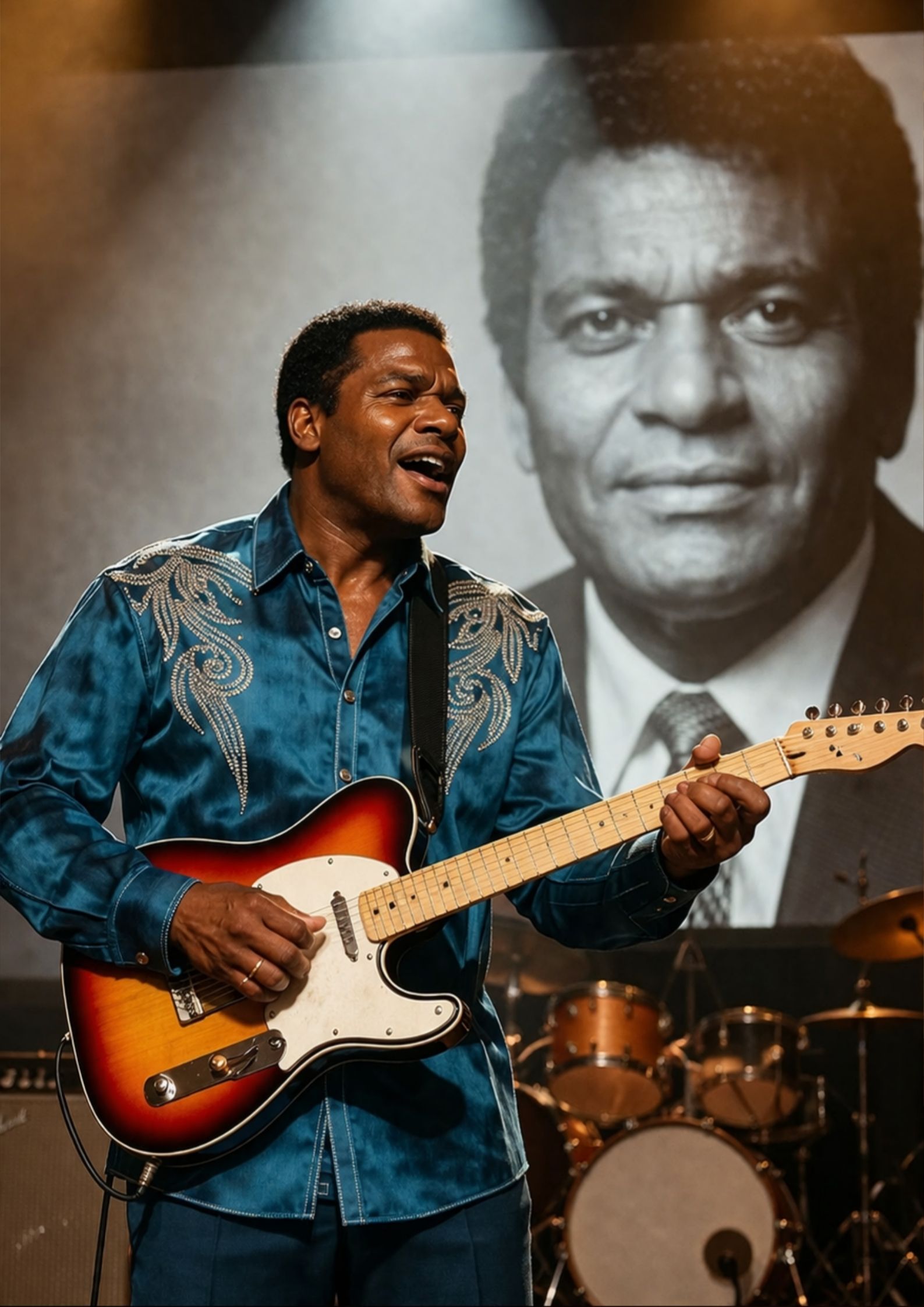
Introduction
HE COULDN'T TAKE THE STAGE — SO HIS SON STEPPED INTO A LEGACY THAT COULDN'T BE BORROWED
Branson, Missouri. Mid-1990s. A winter crowd gathered beneath warm lights, filling every seat of a theater built not just with wood and steel—but with years of music, memory, and trust. For decades, a night with Charley Pride meant something certain. Fans came not only for the songs, but for the man himself—the voice that had carried them through heartbreak, joy, and everything in between.
But that December, something was different.
The name on the marquee was the same. The expectations were the same. But the man they had come to see would not be walking onto that stage.
Surgery had taken Charley Pride off the road—at least for a while. For many artists, that might have meant canceled shows, refunds, and silence. But Charley was not like most artists. He understood something about music that goes beyond performance. He understood legacy.
And so, instead of closing the curtain, he made a decision that surprised nearly everyone.
He called his son.
Dion Pride.
Not a polished Nashville star. Not a seasoned replacement act. His own flesh and blood. A young man who, until that moment, had never faced a test quite like this one.
Three sold-out nights.
A theater filled with loyal fans expecting a legend.
And a son carrying nothing but a guitar—and a last name that could either open doors… or become a weight too heavy to carry.
Charley himself reportedly joked that Dion "may have bitten off more than he could chew." But beneath that humor was something deeper. Perhaps even a quiet belief. Because no father steps aside like that unless he senses something waiting to be discovered.
Still, belief doesn't make the moment easier.
Imagine walking onto a stage where every seat holds someone who came to hear your father. Imagine knowing that every note will be compared—not just to the standard of music, but to a lifetime of memories tied to a single voice.
That is not just a performance.
That is a reckoning.
But Dion Pride made a choice that would define those nights in Branson.
He didn't try to be Charley Pride.
He didn't imitate the voice. He didn't borrow the mannerisms. He didn't chase the shadow of a legend.
He simply played.
And sometimes, that is the hardest thing a person can do—to stand in a place filled with expectation and choose authenticity over imitation.
The first night began with uncertainty. You could feel it in the room. Polite applause. Careful listening. A crowd unsure of what they were about to witness.
But something shifted.
Not all at once—but slowly, steadily, like a sunrise you don't notice until the light is already there.
Dion's voice found its footing. His presence grew more confident. And the audience, almost without realizing it, began to lean in—not to compare, but to understand.
By the second night, word had started to spread.
Around Branson, people began talking—not about a replacement show, but about something unexpected. Local media picked up the story. Conversations moved from curiosity to respect. And the theater, already full, felt somehow even more alive.
By the third night, something remarkable had happened.
The crowd wasn't there to see "Charley Pride's son."
They were there to see Dion Pride.
And that distinction—quiet as it may seem—meant everything.
Because the hardest stage to earn is not the one with the biggest audience. It's not the Grand Ole Opry. It's not even a sold-out theater in Branson.
It's the stage your father already owns.
It's the place where every success invites comparison, and every mistake feels magnified. It's where identity must be carved out—not given.
And on those three nights, Dion didn't inherit that stage.
He earned it.
Somewhere away from the spotlight, recovering from surgery, Charley Pride was watching—or at least imagining what was unfolding. One can only wonder what he felt in those moments. Pride, certainly. But perhaps also something quieter. A recognition that the music he had carried for so long no longer rested solely on his shoulders.
It had found another voice.
Not a replacement.
But a continuation.
Because legacy is not about duplication. It is not about creating another version of what already exists. It is about allowing something new to grow from what came before—strong enough to stand on its own, yet rooted in something deeper.
Those nights in Branson were never meant to be historic.
There were no grand announcements. No national headlines waiting to be written. Just three evenings of music, uncertainty, and quiet courage.
And yet, in their own way, they became unforgettable.
Because they revealed something rarely seen in the world of fame.
Not the rise of a star.
But the emergence of a voice.
A son stepping forward—not to replace his father, but to prove that a name is only the beginning of a story.
And that sometimes, the greatest gift a legend can give… is the chance for someone else to be heard.