RILEY KEOUGH WATCHED AUSTIN BUTLER BECOME ELVIS—THEN CRIED FOR AN ENTIRE WEEK
Introduction
RILEY KEOUGH’S VERDICT ON AUSTIN BUTLER: The Elvis Performance That Left His Own Granddaughter in Tears for a Week
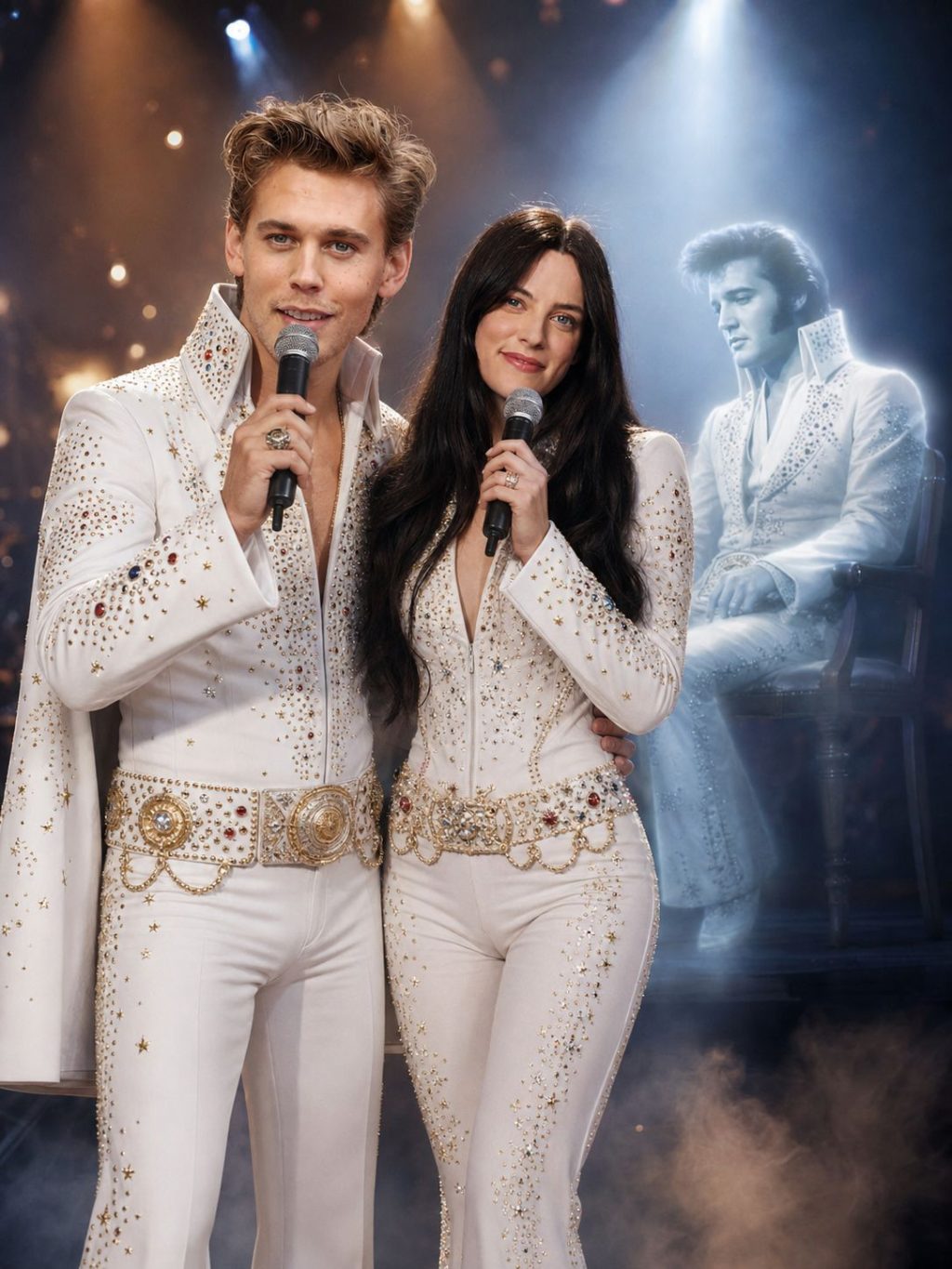
When Riley Keough first watched Austin Butler portray her grandfather in the film Elvis, she was not simply evaluating an actor’s skill. She was watching a stranger attempt something that few performers could ever approach without enormous risk: bringing Elvis Presley back to the screen as a recognizable human being rather than a collection of famous gestures, costumes, and familiar expressions. For Keough, the experience became far more emotional than an ordinary film screening. By the time she left the theater, she felt compelled to contact Butler immediately, even though they had never met.
Her response was direct and deeply personal. Keough described Austin Butler’s performance as outstanding, remarkable, and almost impossible to imagine until she saw it completed. She had known her grandfather largely through family memories, private stories, photographs, recordings, and the cultural legacy that continued surrounding her family long after his death. The public knew Elvis as the King of Rock and Roll, but Keough also understood that behind the title was a complicated man whose generosity, sensitivity, ambition, frustration, humor, and temper could not be reduced to a stage impression.
That distinction explains why Butler’s work affected her so profoundly. Elvis Presley has been imitated by countless entertainers across the world. His voice, hairstyle, clothing, movements, and manner of speaking became so instantly recognizable that imitation gradually turned into its own form of entertainment. Yet the more frequently Elvis was copied, the easier it became for the original person to disappear behind the imitation. The legend sometimes overwhelmed the man.
Keough suggested that previous representations had too often made Elvis appear like a caricature. Such portrayals may reproduce the visible signs audiences associate with him, but they can miss the emotional contradictions that made him compelling. A convincing performance requires more than learning how Elvis moved his shoulders, held a microphone, or addressed an audience. It requires an understanding of the tension between public confidence and private vulnerability.

According to Keough, Butler managed to discover that humanity. He did not present Elvis as a flawless hero, nor did he reduce him to a tragic symbol destroyed by fame. Instead, he captured a person capable of tenderness and anger, warmth and impatience, extraordinary confidence and profound uncertainty. Riley Keough recognized her grandfather’s kindness, but she also recognized his more difficult moments. That balance made the portrayal feel honest rather than worshipful.
For a family member, such honesty can be more respectful than perfection. Families rarely remember loved ones as simple figures. They remember contradictions, ordinary habits, changing moods, private jokes, disappointments, and moments of unexpected generosity. Keough’s praise therefore carried unusual authority. She was not claiming that a film could recreate every aspect of her grandfather, but she believed Butler had reached something emotionally authentic enough to affect those who knew Elvis beyond his public image.
The power of the experience was immediate. Keough explained that she sent Butler a text message as soon as she left the theater. They had not yet met, but waiting for a formal introduction felt unnecessary. She was overwhelmed by what she had seen and wanted him to know that his work had reached the Presley family in a meaningful way.
Butler’s reported reply reflected the seriousness with which he had approached the role. He told her, in essence, that the family’s approval meant a great deal to him. For an actor portraying a widely admired historical figure, public praise is valuable. For Butler, however, the response from Elvis Presley’s family carried a different weight. It suggested that the performance had not merely entertained audiences; it had honored memories belonging to people for whom Elvis was never just a celebrity.
Keough later revealed that she remained in tears for nearly a week. Her emotional reaction came from the film as a whole, but Butler’s portrayal was central to it. Watching Elvis’s story unfold onscreen meant confronting a family history that had long existed in pieces: iconic photographs, concert footage, newspaper headlines, private recollections, and the consequences of a fame that shaped several generations.
A film gathers those fragments into a continuous experience. It gives movement to familiar images and places moments separated by decades into a single narrative. For Keough, this may have made the past feel unusually close. She was not simply remembering Elvis; for several hours, she was watching someone seem to inhabit his physical and emotional world.
That kind of resemblance can be comforting, but it can also be unsettling. The actor’s face is not the same face, yet certain expressions may suddenly appear familiar. A movement, a glance, or the tone of a sentence can awaken memories that photographs cannot reach. Butler’s achievement was not that he disappeared completely into Elvis, because no actor can literally become another person. His achievement was that he created enough emotional truth for the family to recognize something valuable within the portrayal.
Keough’s comments also reveal why the film resonated with viewers who had followed Elvis from the beginning. Older audiences remember the extraordinary speed of his rise and the cultural reaction that followed. They remember when his music seemed new, controversial, and capable of changing the atmosphere of a room. They saw him leave for military service, appear in motion pictures, return through the celebrated 1968 television special, and later perform beneath the intense lights of Las Vegas.
Those viewers also remember the sadness of his final years and the shock of his death in 1977. Their relationship with Elvis was not created retrospectively through documentaries. It developed in real time, alongside marriages, children, careers, losses, and social change. Watching Butler recreate that journey could therefore feel like revisiting part of their own lives.
However, nostalgia alone would not have satisfied such an audience. Anyone familiar with Elvis’s recordings can recognize when an imitation remains superficial. Butler needed to communicate the young performer’s early uncertainty, his increasing command of the stage, and the emotional isolation that can accompany success on an unimaginable scale. He also needed to show that fame did not erase the Southern son, gospel listener, friend, father, and private man beneath the public identity.
Riley Keough believed he succeeded because he found the nuances. Her use of that idea is important. Nuance exists in the spaces between obvious emotions. It appears when kindness contains exhaustion, when anger hides fear, or when confidence is maintained through effort rather than certainty. These are difficult qualities to perform because they cannot be conveyed through costume or choreography alone.
Butler’s long preparation for the role became widely discussed, but Keough’s reaction offers a more meaningful measure of its value. Technical accuracy can impress a general audience, yet emotional recognition from the family suggests something deeper. She saw not only the famous figure the world adored, but traces of the individual her family remembered.
The interview itself remained warm and conversational. There was humor in the suggestion that Butler had probably saved Keough’s text message, and perhaps he did. Such a message would represent more than praise from another performer. It would be a reminder that the risk, discipline, and emotional responsibility of playing Elvis had been recognized by someone carrying the Presley legacy.
For Keough, the film became both a tribute and a confrontation with grief. Elvis had died before she was born, yet his absence shaped the family into which she entered. His music remained present, his image remained visible, and public interest in him never disappeared. The grandfather she could not know personally was nevertheless everywhere.
Watching Butler may therefore have created an unusual feeling: encountering a version of someone both intimately connected to her and historically distant from her. The tears were not simply evidence that the film was sad. They reflected the complicated experience of seeing family history transformed into art.
Austin Butler did not give Riley Keough her grandfather back, and the film could never promise such a thing. What he gave her was a portrayal that resisted mockery and simplification. He approached Elvis not as an impersonation to be perfected, but as a human life to be understood.
That is why Keough’s verdict remains so powerful. She did not praise Butler only because he looked convincing under the lights. She praised him because he found the man beneath the King. In a story repeatedly overshadowed by fame, mythology, and tragedy, Austin Butler allowed Elvis Presley’s humanity to become visible again.